
The government wants to give your kid $1,000, and my advice is to take it. The harder question is whether any of your own money should follow.
For ages, the default investment account for a child has been the UTMA. You open one at any brokerage, fund it, and buy whatever you like: stocks, bonds, T-bills, gold, foreign funds, or all of them. The new Trump Account trades away that flexibility in exchange for one thing a UTMA will never have, which is the ability to receive the Treasury's and billionaires' money. There is the federal $1,000 seed contribution, possible employer contributions, and Michael Dell's $250. Free money compounding for eighteen years is a good deal at almost any valuation.
The account itself is a child IRA with its own set of rules during the so-called growth period, which runs until January 1 of the year the kid turns 18. During that stretch you generally cannot take money out, and you cannot buy what you want. The menu is limited to a handful of low-cost U.S. equity index funds: Treasury defaults everything into SPYM and has approved IVV, VTI, SPTM, and ITOT as alternatives. There is no provision for international stocks, value funds, bonds, bills, or even cash. It is a US large-cap account until the child is nearly grown.
The mechanics
The child needs a Social Security number and cannot have turned 18 before the end of the year the election is made. Private contributions, meaning money from parents, family, and employers, are capped at $5,000 a year for 2026 and 2027, inflation-indexed after that. An employer can contribute up to $2,500 without it landing in the employee's income, though it still counts toward the cap. The federal seed money and qualified rollovers do not count toward the cap at all. Contributions are not deductible, and unlike a Roth IRA, no earned income is required. Any kid with an SSN qualifies.
The $1,000 federal pilot is limited to US citizen children born from January 1, 2025 through December 31, 2028. You claim it by filing Form 4547 or using the tool at trumpaccounts.gov, and for 2026 the election can be made right on your 2025 return. The easiest way is right in the Trump account app. On top of the federal money, Michael Dell has pledged $6.25 billion; the first 25 million kids age 10 and under in ZIP codes with median household income under $150,000 get an extra $250 each. States and charities can add to qualified groups of children as well. Whether any of that reaches your kid depends on where you live and how the programs shake out, which nobody knows yet.
Don't forget to do this later
Buried in the guidance is the feature that makes these accounts genuinely interesting. A Trump Account does not automatically stop being a Trump Account at 18, but IRS Notice 2025-68 permits the account agreement to provide that the moment the growth period ends, everything transfers automatically into a plain traditional IRA at the same trustee. A traditional IRA means a full investment menu, naked options, leverage and shorting notwithstanding. Check whether your custodian document includes this feature, but even if it doesn't, you should be able to file a form to roll a Trump account into a traditional IRA when the time comes.
The traditional IRA treatment sets up a second opportunity. A 19-year-old student or apprentice with little income can convert the balance to a Roth IRA and pay tax at a rate that rounds to nothing. Keep your records straight (I've been finding that Claude and ChatGPT projects are great for this stuff) since the seed money, employer money, and charitable money generally create no basis, while some other contributions might.
One more wrinkle, pertaining to student aid: because the account is an IRA, it should be invisible on the FAFSA, the same as your 401k, but the DOE hasn't spelled this out for these new accounts yet.
How the alternatives stack up
The right answer for most families involves multiple accounts, so a quick tour is in order.
The 529 remains the cleanest way to save for education: tax-free growth for college, trade school, apprenticeships, and some K-12 costs, often with a state deduction, and you control the account rather than the child. The financial aid treatment is friendly. A parent-owned 529 counts as a parent asset on the FAFSA, assessed at no more than 5.64%, and distributions are not income to anyone. A grandparent-owned 529 does even better, since the assets don't appear on the FAFSA at all, and following the 2024 overhaul the distributions no longer count as student income either (the old 50% income penalty is gone). Private schools using the CSS profile ask their own questions, so the grandparent arrangement mainly helps at FAFSA-only schools. If the kid skips college, unused money can roll into his Roth IRA, subject to a $35,000 lifetime cap, the annual IRA limits, and a 15-year seasoning requirement on the account.
The custodial Roth IRA is the best account on this list if the child has real earned income: tax-free growth, tax-free retirement withdrawals, a full brokerage menu, and no FAFSA reporting. The 2026 limit is $7,500 or the kid's income, whichever is less. Pay the child for legitimate work, document it, and keep the numbers honest (we are running a farm and filing Schedule F).
The UTMA wins on flexibility, but loses on FAFSA. You can do global asset allocation or get degen with it, there's no cap beyond the $19k gift exclusion, and no income requirement. Against that, the kiddie tax applies above $2,700 of unearned income in 2026, the money becomes legally the child's at the age of majority whether you like it or not, and the FAFSA assesses it as a student asset at 20%, roughly four times the parent rate. There is however an escape hatch: move UTMA money into a custodial 529 before applying, and the FAFSA reclassifies it as a parent asset at 5.64%.
The option nobody writes about
There is one more choice, and it never shows up in these comparisons because it isn't a kid account at all: keep the money in your own name.
Every dollar in your own taxable account stays under your control indefinitely. You don't know today which of your children will turn out to be a spendthrift at 21, or at 25 for that matter. You don't know what your own finances will look like in fifteen or twenty years, or whether the family will face a medical bill, a business opportunity, or a down payment that matters more than a custodial account opened when the kid was three. Money in your name can go wherever the need turns out to be greatest. Money in a kid's name is spoken for.
The tax treatment is worse on paper, since dividends and gains land at your rates rather than the child's, with no shelter of any kind. But flexibility has value that never shows up in a tax projection. You can gift appreciated shares later ($19,000 per parent, per kid, per year without touching the lifetime exemption), you can wait and see who the money should actually go to, and anything you still hold at death passes with a stepped-up basis. On the FAFSA it counts as a parent asset at 5.64%, the same friendly rate as a 529, without the education earmark.
Call it the mentally-earmarked account: legally yours, informally theirs. For a family that doesn't know what the next two decades hold, a good share of the kids' money probably belongs in this bucket.
Now about that valuation
The Shiller CAPE on the S&P 500 stood at 41.02 on June 30, up from 36.11 a year earlier, which puts the Shiller earnings yield at 2.44%. CAPE tells you nothing about next quarter, but starting valuation remains the most reliable input into long-run returns, and today's starting point is rich by any historical measure. An eighteen-year horizon covers a lot of sins, though Japanese investors who bought in 1989 might have something to say about that.
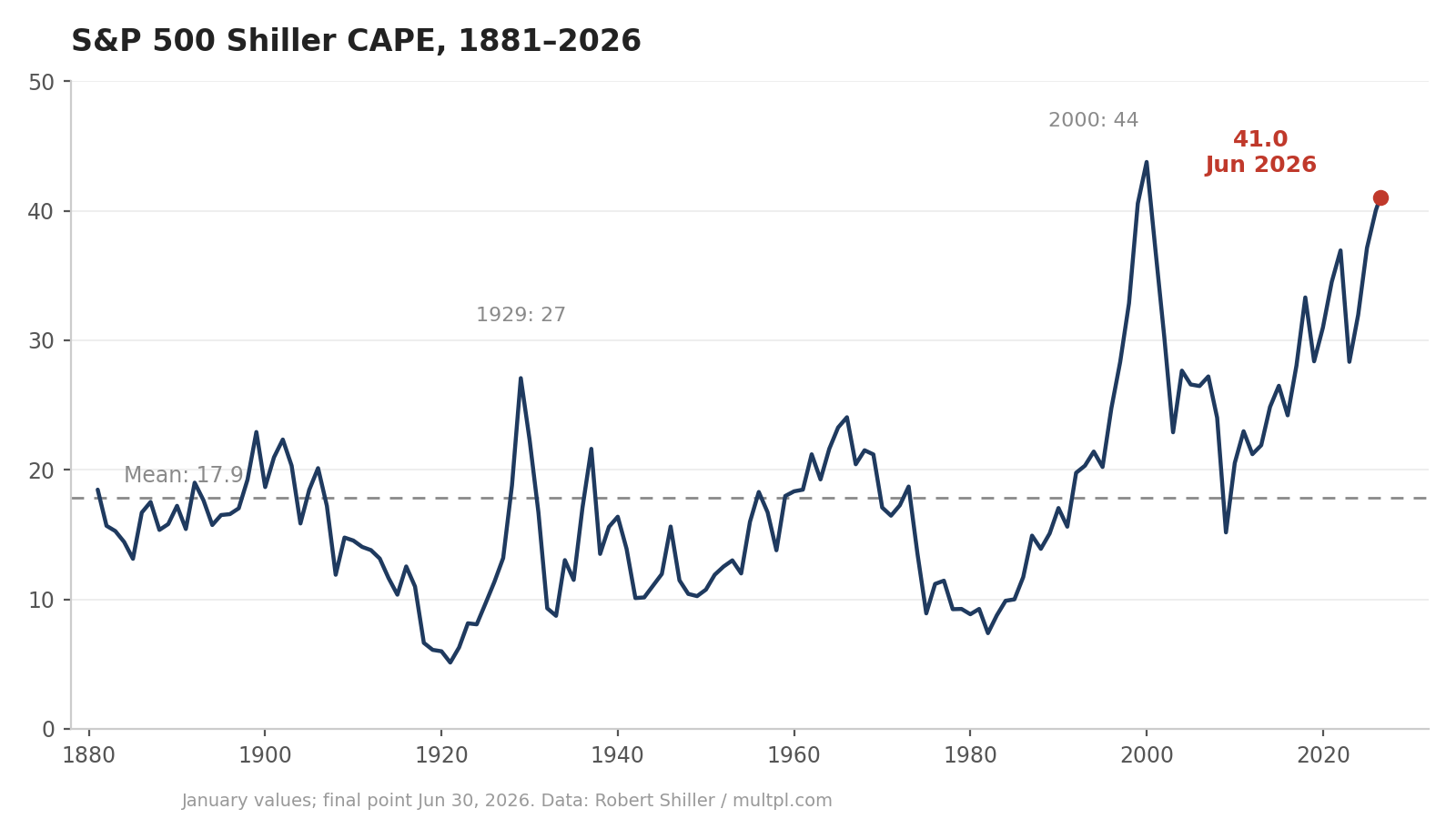
Rich valuations are a headwind in any account. What makes them a Trump Account problem specifically is that the account offers no alternative. Put money in a UTMA at CAPE 41 and you can tilt toward value, buy foreign markets, hold bonds, or sit in bills. Put money in a Trump Account and you have made a forced, concentrated allocation to the most expensive major equity market in the world, locked up until the child is nearly an adult. Maybe that works out fine. But it should be a deliberate allocation decision, weighed against everything else the child owns, not a reflex.
What I would do
Take the free money. File the form, claim the $1,000, collect the Dell $250 if your ZIP code qualifies, and let it compound in an index fund.
Then fund the accounts that actually fit your family: a 529 for education, grandparent-owned where the family structure allows it; a custodial Roth the day the child has legitimate wages; a UTMA when flexibility matters more than tax shelter and you can live with handing over the keys at 21. And keep a healthy share in your own name, mentally earmarked but legally yours, until you know more about who your children turn out to be. We have five, and I wouldn't price the odds that all of them handle money well at 21 very generously.
And if you feel the urge to send another $5,000 a year into the Trump Account, ask yourself whether you would put that money into an S&P 500 fund you couldn't touch for eighteen years. If the answer comes easily, go ahead. If you had to think about it, you already have your answer.
Get the Newsletter


